
Neural Artefacts
The projects deliberately express the ‘Janus problem’ as a form of AI aesthetics embedded in today’s text-to-3D diffusion models. This commonly generated computational glitch refers to the presence of an object’s canonical view (typically the front view) in several other non-canonical views (e.g., the side and back views), thus resulting in a 3D-generated object with multiple fronts or faces, much like the two-faced Janus, Roman god of beginnings. This glitch is a direct consequence of the inherent non-3D-aware behaviour found in such 3D generative models.
Neural Artefact Black (2023)
Neural Artefact Black is the world’s first built physical public art-bench that is generated directly in 3D with a custom fine-tuned stable dreamfusion model and fabricated in an artisanal way with 100% upcycled wood. Commissioned in March 2023 by Arts House Ltd (on behalf of Singapore’s National Arts Council) and completed in July 2023, Neural Artefact Black (or ‘Re-Store’) forms part of the Civic District Placemaking and Public Art Bench project called ‘Benchmarks’. The art-bench is sited in front of the Asian Civilisations Museum and along the historic Singapore River, thus situating itself conceptually among the antique Peranakan wooden furniture collection in the former and the long-disappeared small wooden boats (sampans) on the latter. The artistic intention is to blend learnt features of both types of artefacts – digitally with their scanned imagery, and materially with the use of abandoned wooden furniture and retired boats.
In strategically leveraging the ‘Janus problem’ in this project, the generated ‘two-faced’ seating composition of the bench was celebrated, resulting in the apparent two-way bifurcation at the leftmost end of its seat. Instead of a typical four-legged bench, this bench only has three legs, of which only two are connected by the lower beam, and the third one remains freestanding. The atypical diversion of the lower beam reinforces the spatial and formal ambiguity as it connects to the leftmost back-facing leg instead of the leftmost front-facing leg. The treatment of the overall surface further heightens the notion of a Janus bench, whereby the front-facing side is charred in black and the back-facing side left uncharred in its original teak texture.
Neural Monobloc Black (2024)


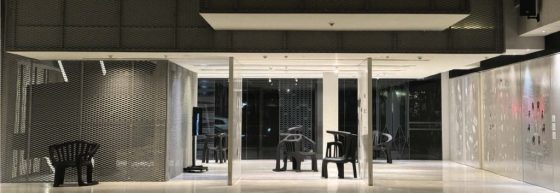
Neural MONOBLOC Black is a series of 8 furniture pieces generated directly in 3D with a custom fine-tuned stable dreamfusion model and fabricated in an artisanal way with 100% upcycled wood. Completed in April 2024, it was exhibited at Singapore’s National Design Centre and National Central Library, with support from DesignSingapore Council and University of the Arts Singapore (UAS), It was also part of a satellite event ‘AI-NITE‘ at the Computer-Aided Architectural Design Research in Asia 2024 (CAADRIA).
The white plastic Mononbloc chair is the world’s most widely produced and disposed chair, yet it is also one that has come to epitomise the mass consumption of unsustainable, cheap, fast, and homogenous design. The project turns the Monobloc on its head by undermining the very notions of optimised machine production and human consumption through the subversive aesthetics of digital artificial intelligence and physical artisanal intuition, inviting everyone to critically reconsider the status quo.