Aastha Valecha
Afterglow
The Hidden Paintings Inside Noise
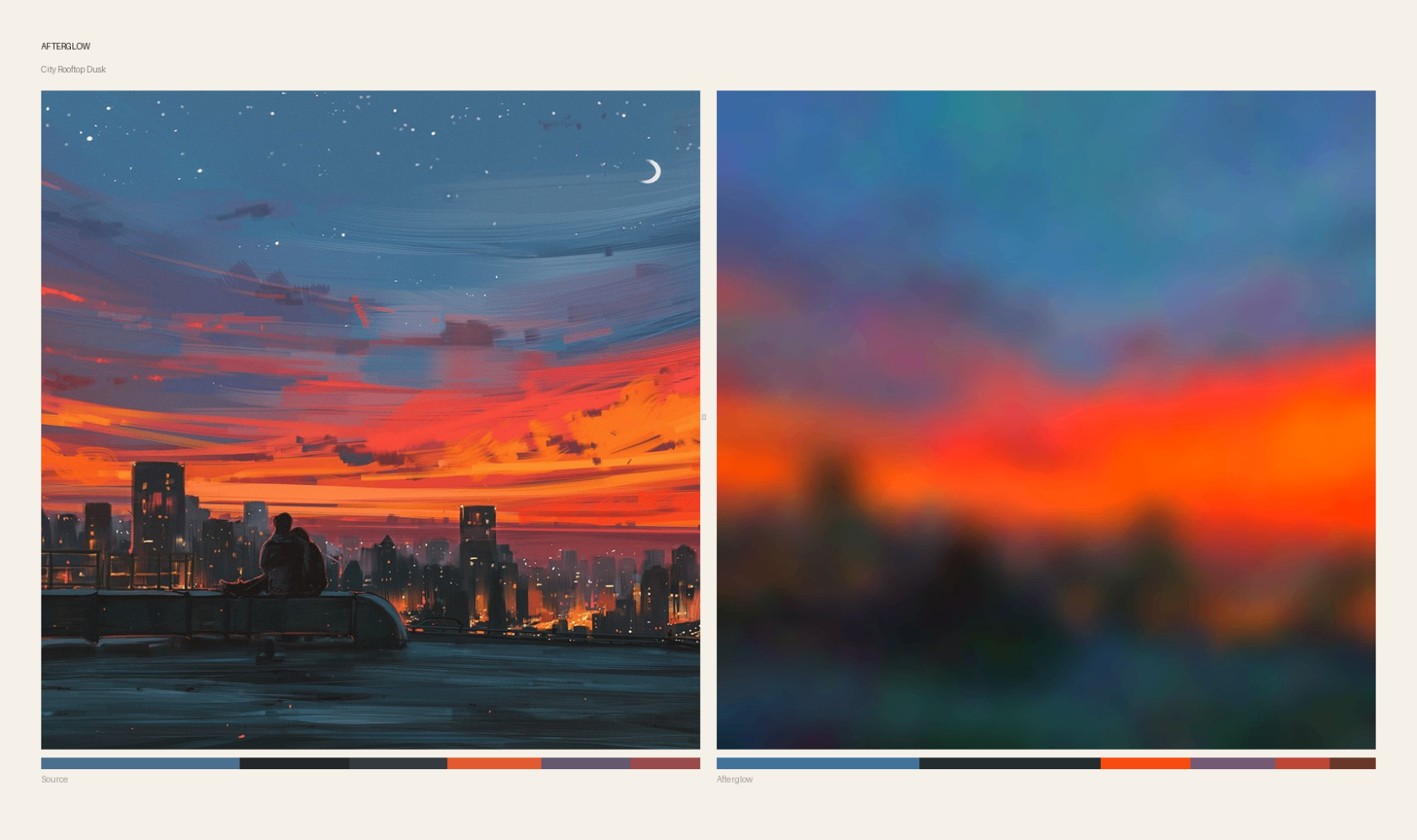
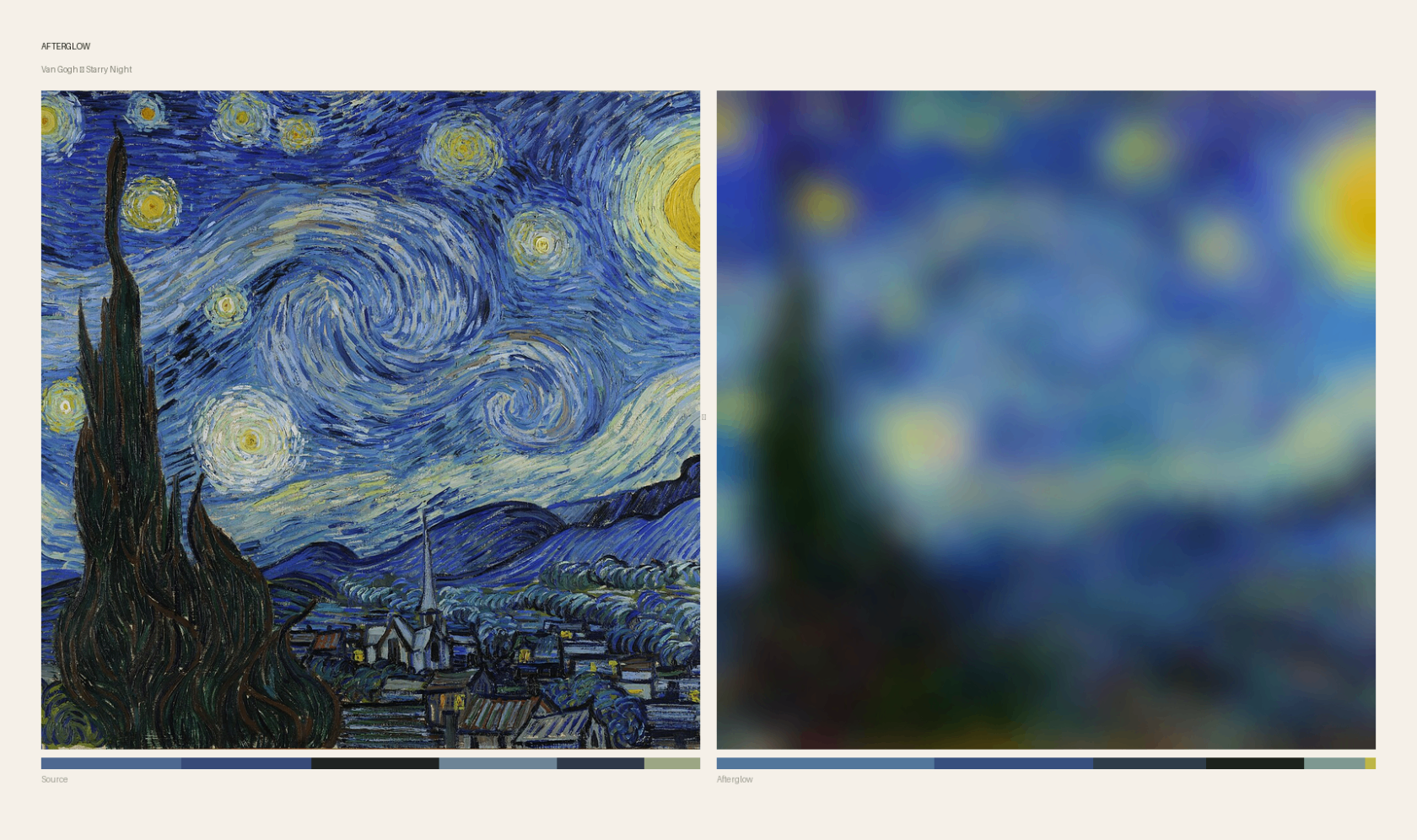
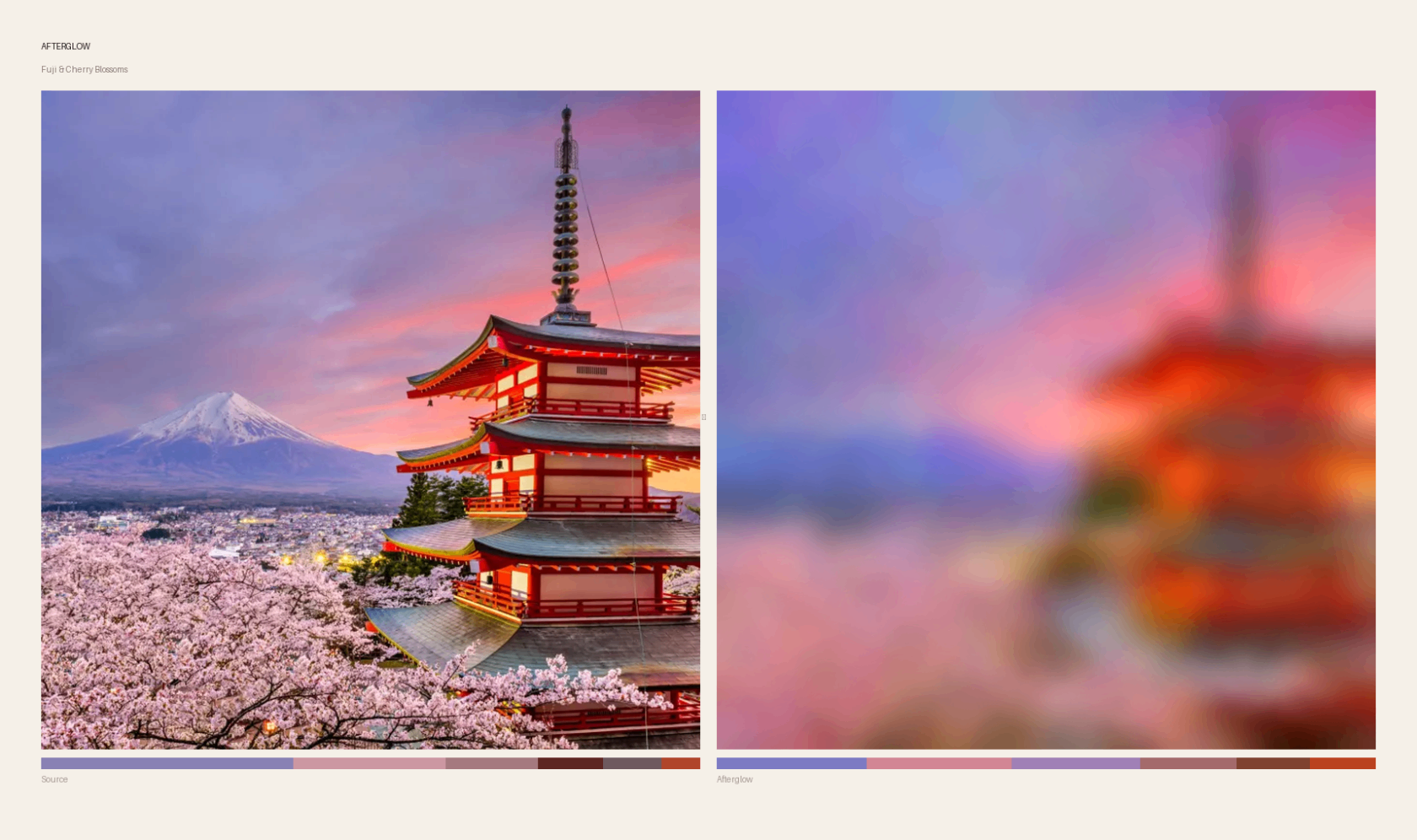
Every image carries a hidden painting within it one that only becomes visible in the moment of the image’s dissolution. AFTERGLOW is a series of large-format abstract works extracted from the liminal space between recognition and noise in diffusion models. When a photograph or painting is subjected to forward diffusion the process by which an image is progressively corrupted with Gaussian noise it passes through a brief, exquisite threshold: the moment where representational content has vanished, yet the color temperature, compositional weight, and emotional frequency of the original still linger.
These afterglow states are accidentally beautiful abstract paintings works that no human composed and no AI was prompted to create. They emerge from the physics of information entropy applied to visual data. They are what remains when everything recognizable has been taken away.
The work reveals a profound asymmetry: in the forward diffusion process, form and structure are the first casualties. Edges dissolve. Faces blur. Objects merge. But color is the last thing to go. Long after you cannot tell what an image depicted, you can still feel its warmth, its palette, its emotional temperature. A sunset’s amber persists far beyond its horizon line. A portrait’s flesh tones outlive the face they once described.
This observation carries weight beyond the technical. It suggests that the most durable quality of any image the quality that survives the longest under entropy is not its content but its feeling. Not what it shows, but what it feels like to look at. The afterglow of a painting is its emotional signature, stripped of all narrative, all representation, all form rendered as pure chromatic atmosphere.
There is also a meditation on impermanence here. Every afterglow is, in a sense, an image in the process of dying. Yet the death is beautiful and the ghost it leaves behind is, unexpectedly, art. The work asks: if the most essential quality of an image is the last to disappear, perhaps it is also the first thing we truly see.


The Physics of Visual Memory
Diffusion models learn to generate images by first learning to destroy them. During training, images are progressively corrupted with noise across a schedule of 1,000 timesteps. At t=0, the image is pristine. At t=1000, it is indistinguishable from pure Gaussian noise. The model learns to reverse this process to denoise and in doing so, learns the structure of all images.
AFTERGLOW inverts the usual relationship with diffusion models. Rather than using reverse diffusion to generate new images, it uses forward diffusion as an artistic instrument. The destruction is the art. The specific visual character of the intermediate states between the original image and pure noise constitutes a previously unexplored aesthetic territory.
Color as Survivor
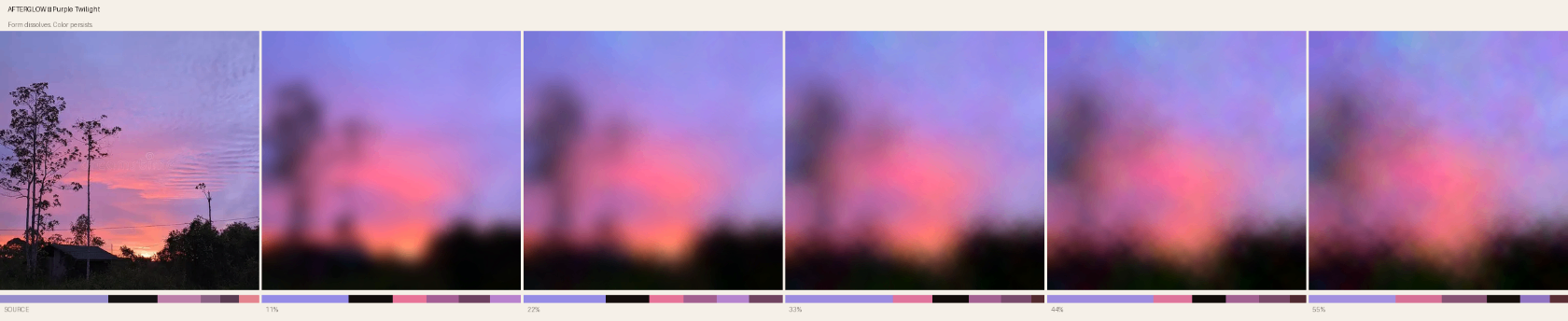
The central discovery of this work is empirical: when dominant color palettes are extracted at each dissolution stage, low-frequency color information persists significantly longer than high-frequency structural information. This is mathematically expected Gaussian noise primarily disrupts high-frequency components but the visual and emotional consequences are unexpected and profound.
A Vermeer and a Rothko, dissolved to 80% noise, become indistinguishable in form. But their color signatures remain distinct. The Vermeer still glows with pearl-light yellows and deep lapis blues. The Rothko still pulses with its characteristic saturated reds. The palette is the last identity.
Relationship to Art History
AFTERGLOW connects to a long tradition of artists working with dissolution, impermanence, and the boundaries of perception: the sfumato of Leonardo, Turner’s atmospheric dissolution of form, Monet’s late water lilies where form dissolves into pure color impression, Rothko’s color fields as emotional experience stripped of representation, and Richter’s squeegee paintings that blur photographic images into abstract chromatic fields.
The work also engages with Japanese aesthetic concepts: mono no aware (the pathos of things, the bittersweet awareness of impermanence) and wabi-sabi (beauty found in imperfection and transience). The afterglow images are beautiful precisely because they are in the process of disappearing.
Pipeline
The process is elegant in its simplicity. A source image is encoded into the latent space of a pre-trained diffusion model (Stable Diffusion 2.1) via its variational autoencoder (VAE). Gaussian noise is then added at precisely controlled timesteps using the model’s DDPM noise scheduler. The noisy latent is decoded back to pixel space through the VAE decoder. No denoising is performed. No prompts are used. No generation occurs. The resulting image is purely the product of the source image’s encounter with calibrated entropy.
Formally, for a source image x₀, the afterglow at timestep t is:
A(x₀, t) = Decode( √(αₜ) · Encode(x₀) + √(1 − αₜ) · ε )
where αₜ is the cumulative noise schedule coefficient and ε is sampled Gaussian noise. The critical artistic parameter is the choice of t: too low and the image is merely blurred; too high and it becomes indistinguishable noise. The “afterglows” live in the narrow band between these extremes, typically in the range t ∈ [500, 900].
Color Palette Extraction
At each dissolution stage, dominant colors are extracted via k-means clustering in RGB space (k=6). The resulting palettes are presented alongside the afterglow images as proportional color bars, creating a visual record of how the image’s chromatic identity evolves under increasing entropy. This dual presentation the atmospheric afterglow above, the analytical palette below bridges the experiential and the systematic.
Novelty & Distinction
AFTERGLOW distinguishes itself from existing AI art in several critical ways:
No generation, no prompts. Unlike the vast majority of AI art, this work does not use AI to generate images from text prompts. The diffusion model is used only for its noise schedule and its VAE the forward process, not the reverse. This is fundamentally different from prompt-based art and positions the work in an underexplored territory.
Destruction as creation. The artistic act is one of controlled dissolution, not construction. The beauty emerges not from what the AI creates but from what survives the AI’s noise process. This inverts the standard creative paradigm.
The liminal aesthetic. The intermediate states of forward diffusion have never been presented as standalone artworks. This is a genuinely unexplored aesthetic space images that exist in the threshold between representation and abstraction, between signal and noise.
Empirical poetics. The observation that color survives longer than form is mathematically grounded but emotionally resonant. The work bridges scientific insight and aesthetic experience in a way that rewards both technical and non-technical audiences.
Elegant simplicity. The entire pipeline requires no training, no fine-tuning, no complex architectures. It uses only the VAE encoder/decoder and a standard noise scheduler. The conceptual power is in the framing, not the computation.
Afterglow-edsheeren
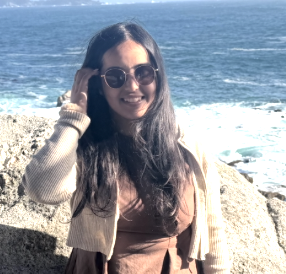
Aastha Valecha is an AI researcher, data scientist, and interdisciplinary creator whose work bridges machine learning systems and human-centered AI. Her technical work focuses on search, ranking, retrieval, cold-start discovery, and evaluation of intelligent systems. Her creative work explores memory, grief, synthetic presence, and the emotional dimensions of AI, using generative systems to examine how technology reshapes remembrance, identity, and human connection.