Andrei Ivănescu, Virgil Ilian, Irina Raicu
FolkLORA
FolkLORA asks: can AI preserve cultural memory, or does it inevitably flatten it?
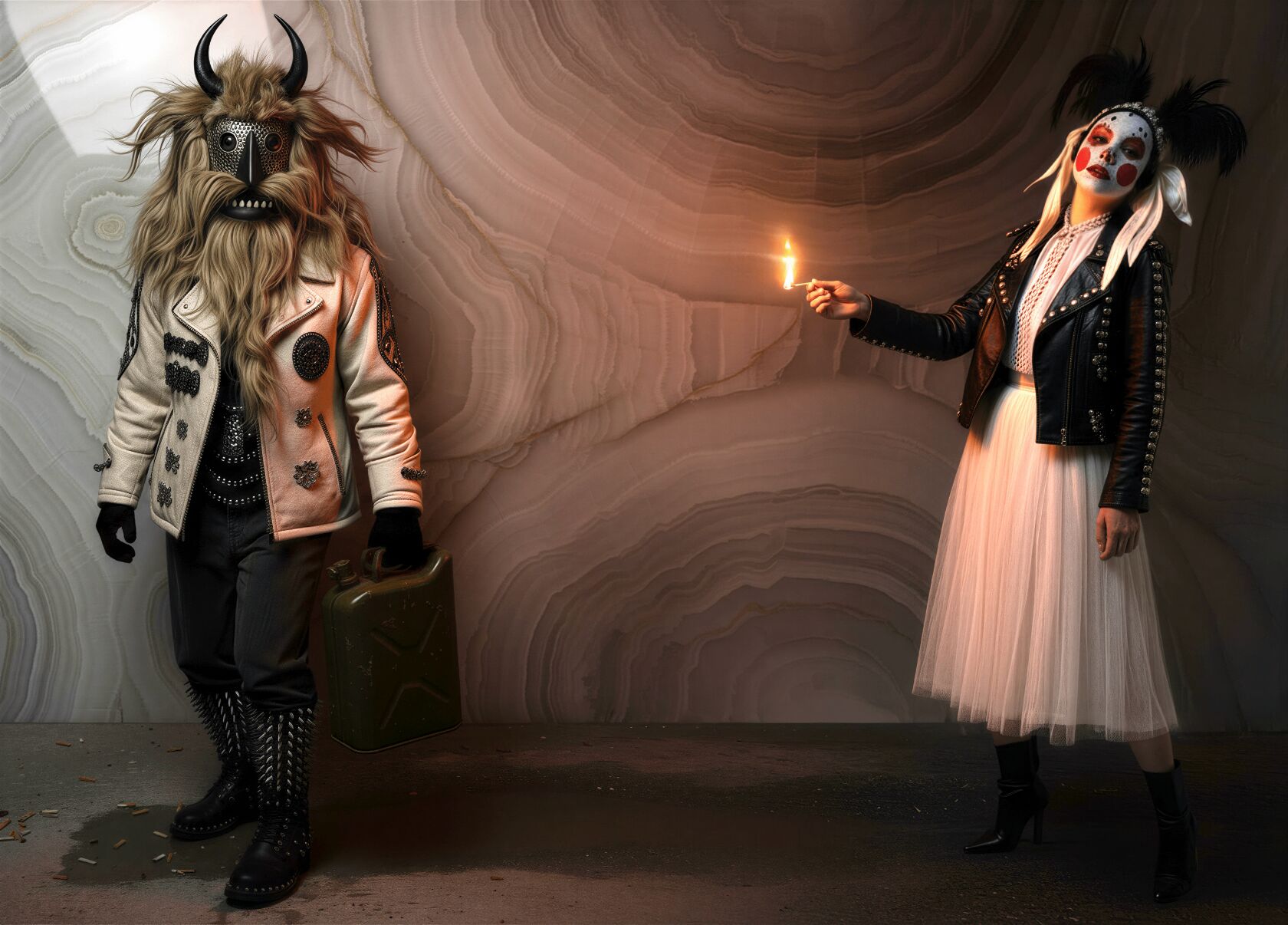
The Artwork FolkLORA is a body of AI-generated images exploring Romanian intangible heritage through deliberate cultural hybridization. The works range from ethnographically faithful reconstructions to speculative fictions: Star Wars characters rendered in Horezu ceramic traditions, folkloric masks reimagined as luxury jewelry, fortified manor houses (cule) transposed into Danube Delta waters or brutalist futures, ritual figures surviving in cyberpunk dystopias.
A participatory validation component invites viewers to distinguish real heritage photographs from AI generations surfacing an "inverse authentication" phenomenon where participants frequently identify authentic artifacts as fake while accepting synthetic images as real. The project's manifesto states: "These objects are both here and not. They were not made by anyone, but drawn from latent space imbued with lived tradition. To be original is finding signal within endless noise."
Computer Vision Techniques We developed six specialized LoRA models trained on ethnographically-curated datasets of three heritage domains: Oltenian fortified houses (cule), Horezu ceramics, and ceremonial masks. A dual-platform methodology embraces AI bias as creative method: SDXL with tag-based annotation enables conceptual hybridization (cross-domain synthesis), while FLUX with narrative captions achieves photorealistic fidelity. Training applies Gaussian-distributed label frequencies to balance stylistic coherence against generative flexibility. All models are open-source (HuggingFace, CivitAI), with generation interfaces via Fal.ai API integration. Artistic & Philosophical Context The work is grounded in folklorist theory (Hobsbawm's "invented traditions," Handler's critiques of authenticity) revealing that "tradition" has always been constructed, curated, strategically reinvented. Our AI models do not corrupt an authentic past they continue an age-old practice of cultural synthesis.
The project equally documents refusal. After dialogue with Roma minority cultural scholars, we chose NOT to create a Roma heritage model, recognizing that for cultures whose essence is oral, adaptive, and non-representational, AI synthesis risks producing "an echo of an already distorted echo." This documented limit when NOT to generate is itself a contribution.