Danlin Huang, Ke Huang, Ruoqi Wang & Botao Amber Hu
Body Oracle
Artist: Danlin Huang, Ke Huang, Ruoqi Wang, Botao Amber Hu
DATE: 2025
Link: https://danlinhuang.com/body-oracle
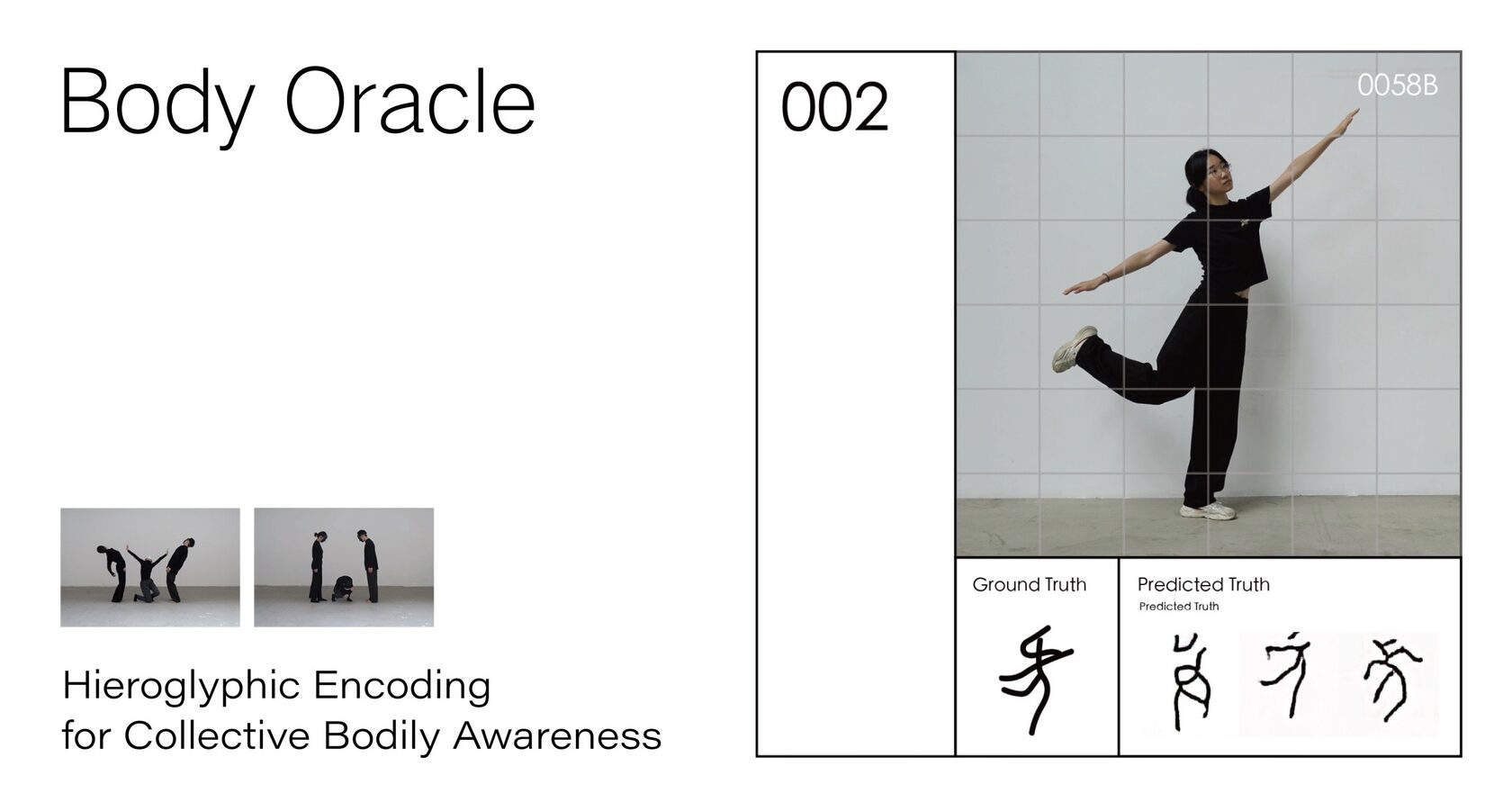
In our modern information age, we face a deficit in bodily awareness during digital communication, despite Mehrabian's 7-38-55 rule suggesting that body language conveys 55% of meaning. Our current vocabulary struggles to describe complex bodily phenomena such as proprioception and social proprioception—the awareness of one's own and others' spatial body positioning. Body Oracle is a computational linguistic speculative design project, introducing an alterative language system of AI-generated hieroglyphic characters representing corporeal and intercorporeal poses inspired by ancient Chinese Oracle-Bone Inscriptions. These intuitive, cross-linguistic, cross-cultural signs—akin to emojis—aim to expand our capacity to conceptualize, understand, and communicate bodily and inter-bodily experiences. Drawing on linguistic relativity—the idea that language shapes worldview—we propose that these new hieroglyphic signs will function as a sociolinguistic mediator, influencing collective semantic cognition of bodily awareness. By envisioning an alternative present, Body Oracle challenges us to reconsider how embodied communication can transform our shared understanding.
In today's information age, we predominantly communicate through text—messages, emails, and web pages. According to Mehrabian's 7-38-55 rule, spoken words convey only 7% of meaning, while tone of voice comprises 38% and body language accounts for 55%. Though emojis help express emotion, digital communication remains fundamentally "disembodied" , lacking the immediate bodily cues essential for deep human connection. This heavy reliance on online exchanges weakens our ability to express and interpret body language, resulting in misunderstandings, communication breakdowns, decreased empathy, and diminished social support and well-being.
Our linguistic limitations compound this issue: both Western and Eastern vocabularies lack precise terminology for proprioception and social proprioception—our sense of body positioning in space, both individual and collective. This linguistic gap limits our ability to articulate and understand crucial concepts of embodied nonverbal interaction.
What if our language included characters that inherently heightened our awareness of body language, similar to how emojis convey emotion?
In response, we propose "Body Oracle," a computational linguistic speculative design project. We envision an "alternative present" with an alternative language system capable of describing complex proprioceptions. Inspired by Chinese oracle bone inscriptions (OBI), one of the oldest forms of Chinese writing, we draw upon their elegant pictographic nature where simplified strokes mirror the objects they represent. Through strokes that sketch bodily positions, we capture spatial relationships in their most intuitive form. Based on this inspiration, "Body Oracle" introduces AI-generated hieroglyphic characters that represent corporeal and intercorporeal poses, mapping the spatial relationships between bodies. These intuitive, cross-linguistic, cross-cultural signs—similar to emojis—may expand our ability to conceptualize, understand, and communicate bodily experiences.
Our contributions center explicitly on the computational and speculative methodology underpinning Body Oracle, demonstrating how somatic awareness can be enriched through AI-generated embodied symbols. And also including revitalizing ancient heritage, experiential alternative present and exploring the pathway to somaesthetic futures. Drawing from Wittgenstein’s linguistic relativity—that the limits of language define the limits of our world—we speculate that Body Oracle can expand our collective semantic cognition through enhanced embodied awareness.