Gradient Spaces
An AR Community Art Project
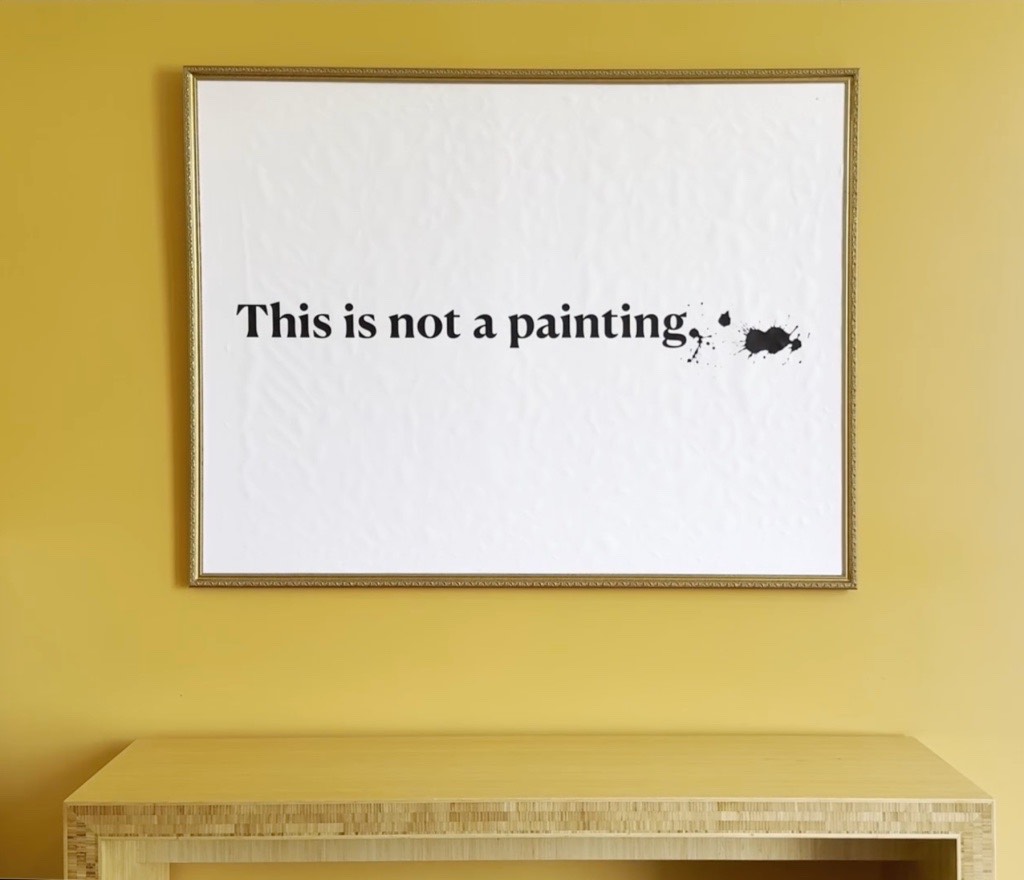
Gradient Canvas is an augmented reality (AR) community art project that blurs the boundaries between the physical and digital worlds through collective creativity. In the physical space, the artwork presents an empty canvas with the inscription: "This is not a painting" — a playful homage to René Magritte's famous work "The Treachery of Images" ("Ceci n'est pas une pipe"). However, in the digital realm, the canvas is alive and ever-evolving, shaped continuously by the creative input of interacting users.
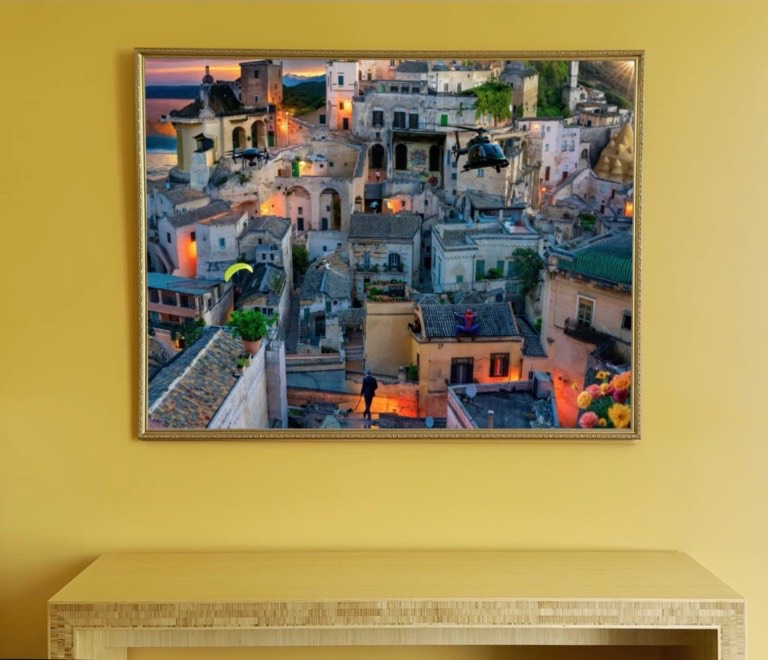
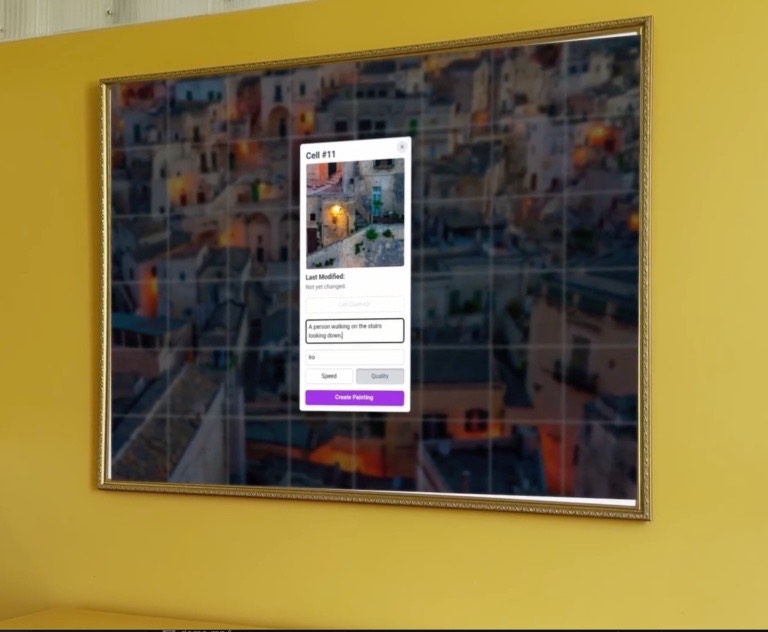
By scanning a QR code displayed beside the physical frame, viewers unlock an AR experience where the current digital canvas overlays seamlessly onto the empty frame. Users can explore a historical timeline of all previous canvases, witnessing the project's evolution, or engage directly with the canvas. Those who choose to interact are invited to select a region of the canvas to modify. Through a simple text prompt, users guide a diffusion model to generate and inpaint new content within their chosen area. This interaction allows the canvas to organically transform over time, reflecting the collective imagination of its participants.
Check the canvas as it evolves over time here: https://gradientcanvas.github.io
Inspiration and Vision
Gradient Canvas draws inspiration from Reddit Place, reimagining its collaborative spirit through the lens of advanced generative AI and augmented reality. It invites participants to engage in a playful yet profound dialogue between technology and creativity, fostering a shared digital tapestry that evolves with every interaction.
By blending collective artistry with cutting-edge computer vision, Gradient Canvas explores how digital and physical realities intertwine, offering a living artwork that is never static—always becoming.
Gallery
Creators
This work is developed by members of the Gradient Spaces Lab, Stanford University (alphabetically): Iro Armeni, Martin Juan José Bucher, Sayan Deb Sarkar, Emily Steiner, Tao Sun, Jianhao Zheng, and Liyuan Zhu. We also thank Ata Celen, Ayca Duran, and Zhizhuo Zhou and for their contributions.
The Gradient Spaces Lab belongs to the Civil and Environmental Engineering Department, Stanford University, under the Schools of Engineering and Sustainability. Our research and educational activities focus on developing quantitative and data-driven methods that learn from real-world visual data to generate, predict, and simulate new or renewed built environments that place the human in the center. Our mission is to create sustainable, inclusive, and adaptive built environments that can support our current and future physical and digital needs. Of particular interest is the creation of spaces that blend from the 100% physical (real reality) to the 100% digital (virtual reality) and anything in between, with the use of mixed reality and multi-level design (i.e., of buildings, processes, UXs, etc.). We believe that by cross-pollinating the two domains, we can achieve higher immersion and view these spaces as a step toward more equitable living conditions. Hence, we aim for developing methods that work in real-world settings on a global scale. To achieve the above, we are building a cross- and inter- disciplinary team that is diverse and well-rounded. Most importantly, we are driven by curiosity and learning, and so does everything we do.