Aesthetics
Kuan Yew LEONG
Glitch as Intention [2025]
~ The Wabi-Sabi of AI Art
Introduction
In an era where artificial intelligence strives for precision, optimization, and flawlessness, Glitch as Intention stands as a meditation on the beauty of imperfection. Rooted in the Japanese philosophy of Wabi-Sabi (侘び寂び), this work reimagines computational glitches not as errors, but as profound moments of aesthetic significance. It challenges the rigid ideals of perfection that define contemporary computer vision systems and, instead, embraces the unpredictability and transience that lie at the heart of both human creativity and machine learning. Glitch aesthetics usually focus on human artistic interpretation. This work, however, demonstrates how they are interpreted by AI models. This could explore the tension between human aesthetics and machine failure, which is rarely addressed in traditional glitch art. There has been considerable discussion and numerous artistic explorations centered around the concept of wabi-sabi in digital art too. However, a critical gap remains: the lack of a structured approach to understanding how different types of computer vision glitches influence the final aesthetic of AI-generated artwork. Existing works often explore these distortions in an abstract or isolated manner, without systematically categorizing and analyzing their distinct visual impacts. Additionally, existing works focus on two approaches: (1) prompting models to generate wabi-sabi-inspired aesthetics or (2) fine-tuning models to produce polished, curated imperfections. However, these approaches often overlook the core philosophy of wabi-sabi—embracing the incomplete, the fleeting, and the beautifully flawed."This project reinterprets computational glitches not as errors to be corrected, but as moments of profound aesthetic significance. By showcasing AI-generated art shaped by different types of computer vision glitches, we reveal an organic, unintended beauty—one that truly aligns with the essence of wabi-sabi."Glitch Types Glitch as Intention addresses the above gaps by identifying and categorizing 12 major types of computer vision glitches that significantly alter AI-generated art: ⤵
- Analog distortions from hardware malfunctions, Pixel scrambling, Digital dithering, Data moshing, Video frame skips/tearing, Data compression artifacts, Color banding, Digital channel shifts, Noise and grain (analog), Over-exposure, Signal noise (snow/static), Moiré patterns, Combination of all the above
→ Visit the project site for more art pieces.
Below are some featured examples.Echoes of the Digital Tempest
This artwork merges the timeless beauty of Japanese Ukiyo-e waves with the unpredictable chaos of digital distortion. The presence of pixelated errors, scan-line artifacts, and glitch-inspired warping transforms this traditional masterpiece into a symbol of the digital era’s reinterpretation of history. It raises the question: What happens when AI attempts to recreate human art? Does it preserve the essence, or does it introduce its own biases and distortions? This artwork also plays with the concept of time loops and echoes, suggesting a world where past and future collide—traditional craftsmanship meeting machine-generated reinterpretation. The undulating waves resemble sound waves or signal transmissions, hinting at how modern technology "hears" and "sees" classical art. Glitch type: analog distortions from hardware malfunctionsDeconstructed Relic
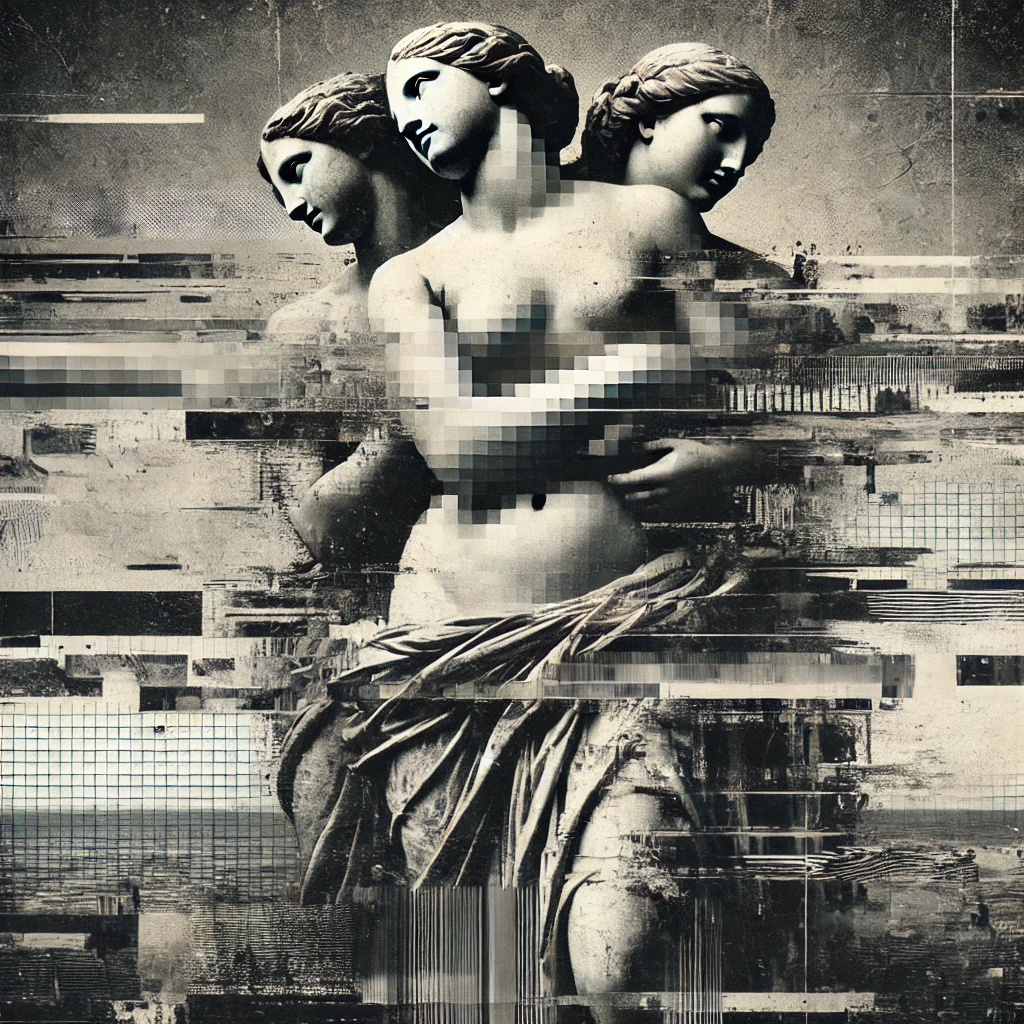
Deconstructed Relic is a striking commentary on censorship, historical reinterpretation, and the erosion of cultural memory in the digital age. The glitch elements further amplify a sense of instability, as though this classical relic is dissolving into a matrix of uncertainty. It invites reflection on modern society’s paradoxical relationship with art—simultaneously revering and censoring it. Glitch type: all combinationBetween Mist and Glitch
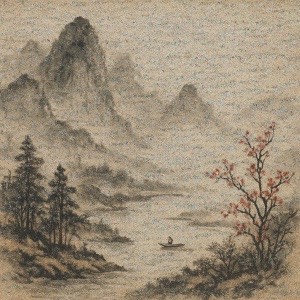
Between Mist and Glitch suspends the viewer in a dreamlike tension — where the permanence of ink meets the instability of signal. Rooted in the brushwork traditions of guó huà (国画 / 國畫), this piece evokes the serenity of ancient Chinese landscapes: mist-cloaked peaks, drifting riverboats, and the timeless hush of nature. But the harmony fractures. Across the stillness, static cascades — not of weather, but of code. The piece refuses clarity, instead offering ambiguity as its subject, inviting the viewer to linger in the blurred boundary where analog dissolves into digital. What is real — the ink that stains the paper, or the glitch that fractures it? Or perhaps, like the human experience itself, truth lies somewhere in between. Glitch type: snow / static (signal noise) → For more context about this project, see "Glitch as Intention". The PhilosophyThe Beauty of Imperfection (不完全の美)
Wabi-Sabi is an aesthetic of incompleteness—one that celebrates irregularities, asymmetries, and the quiet dignity of decay. In the same way that a weathered teacup, its cracks traced with golden Kintsugi (金継ぎ), holds more depth than an unblemished vessel, AI glitch art invites us to appreciate the fractured and distorted. Pixelations, compression artifacts, and latent space errors are not failures; they are the fingerprints of the machine’s process, revealing an unfiltered glimpse into the imperfections of computational creativity. These artifacts, once dismissed as mere noise, become echoes of the unseen, urging us to find beauty in the unintended.Transience in the Digital Realm (無常)
Wabi-Sabi also speaks to the impermanence of all things. Wood weathers, ink fades, and stone erodes—such is the nature of the world. Yet in the digital domain, where data seems immutable, glitches remind us that even information is subject to transformation and decay. Corrupt files, broken algorithms, and unintended distortions are the digital equivalent of time-worn temples and crumbling parchment. This project amplifies these ephemeral qualities, allowing the machine’s imperfections to surface, evolve, and ultimately dissolve into abstraction. The resulting visuals become a study of time, loss, and the fragile nature of digital existence.The Beauty of the Uncontrolled (自然)
Just as a Zen garden’s asymmetry is shaped by the randomness of falling leaves and shifting sands, AI glitch art emerges from the machine’s own biases, limitations, and emergent behaviors. The artist does not impose absolute control but rather engages in a dialogue with the algorithm, allowing its unpredictability to shape the outcome. This collaboration mirrors the organic spontaneity found in nature, where chaos and structure coexist in delicate harmony. By leaning into the unintended, we unlock a new mode of creation—one that acknowledges the machine not as a perfect tool, but as a partner in serendipitous discovery.Subdued and Austere (侘)
Wabi-Sabi values subtlety and restraint, where what is left unsaid is as important as what is spoken. In AI glitch art, missing pixels, fragmented forms, and distorted edges become poetic absences, inviting interpretation rather than delivering absolute clarity. Just as a traditional Sumi-e ink painting embraces negative space to evoke meaning, these digital distortions leave gaps that the human imagination instinctively fills. The imperfect, the incomplete, and the ambiguous become essential components of the aesthetic experience.Failure as a Path to Beauty
A machine's failure to perfectly reconstruct an image is often seen as an error—a deviation from the expected. Yet, just as an aged, cracked tea bowl holds more meaning than a mass-produced cup, AI’s imperfections tell a story. These glitches are not failures but markers of growth, adaptation, and the machine’s own fallibility. In embracing these computational ‘flaws,’ Glitch as Intention redefines failure as a form of artistic evolution—an acknowledgment that even within the realm of artificial intelligence, true beauty emerges not from perfection, but from the elegant embrace of the imperfect.Towards a Digital Wabi-Sabi
"This is not perfection through AI, but an embrace of the incomplete, the glitch-born sublime." ⤵ By aligning AI glitch art with the philosophy of Wabi-Sabi, this work invites viewers to reconsider their relationship with technology—not as a force striving for sterile perfection, but as a medium capable of expressing organic, transient, and deeply human aesthetics. In a world obsessed with high-fidelity images and seamless automation, Glitch as Intention asks: what if we found beauty not in the perfected, but in the broken? What if, instead of seeking to eliminate errors, we allowed them to guide us toward new forms of creative expression? The Artist: Kuan Yew, LEONG (profile link) is a specialist of Computer Vision and Deep Learning based in Kyoto, Japan. Currently, he works on the improvements of computer vision by researching different learning algorithms. Kuan Yew demonstrates a keen interest in the intersection of art, natural science, and technology through the design and development of sophisticated smart paludariums. He maintains a forward-thinking perspective, recognizing that present-day challenges represent opportunities for innovation, and is committed to leveraging technological advancements for future betterment.