Identity
Miguel Ripoll
Grand Tour (2024-2025)
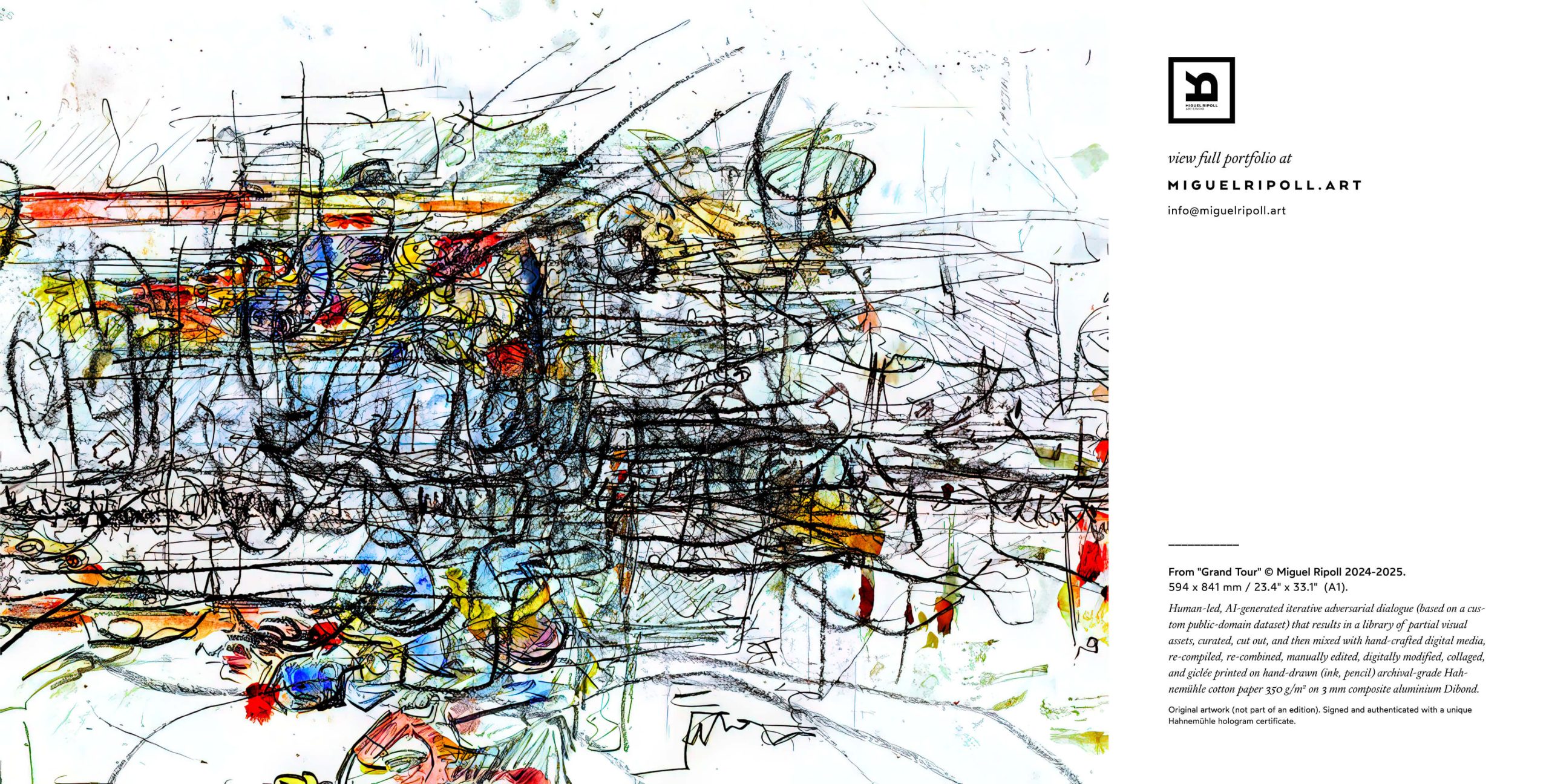
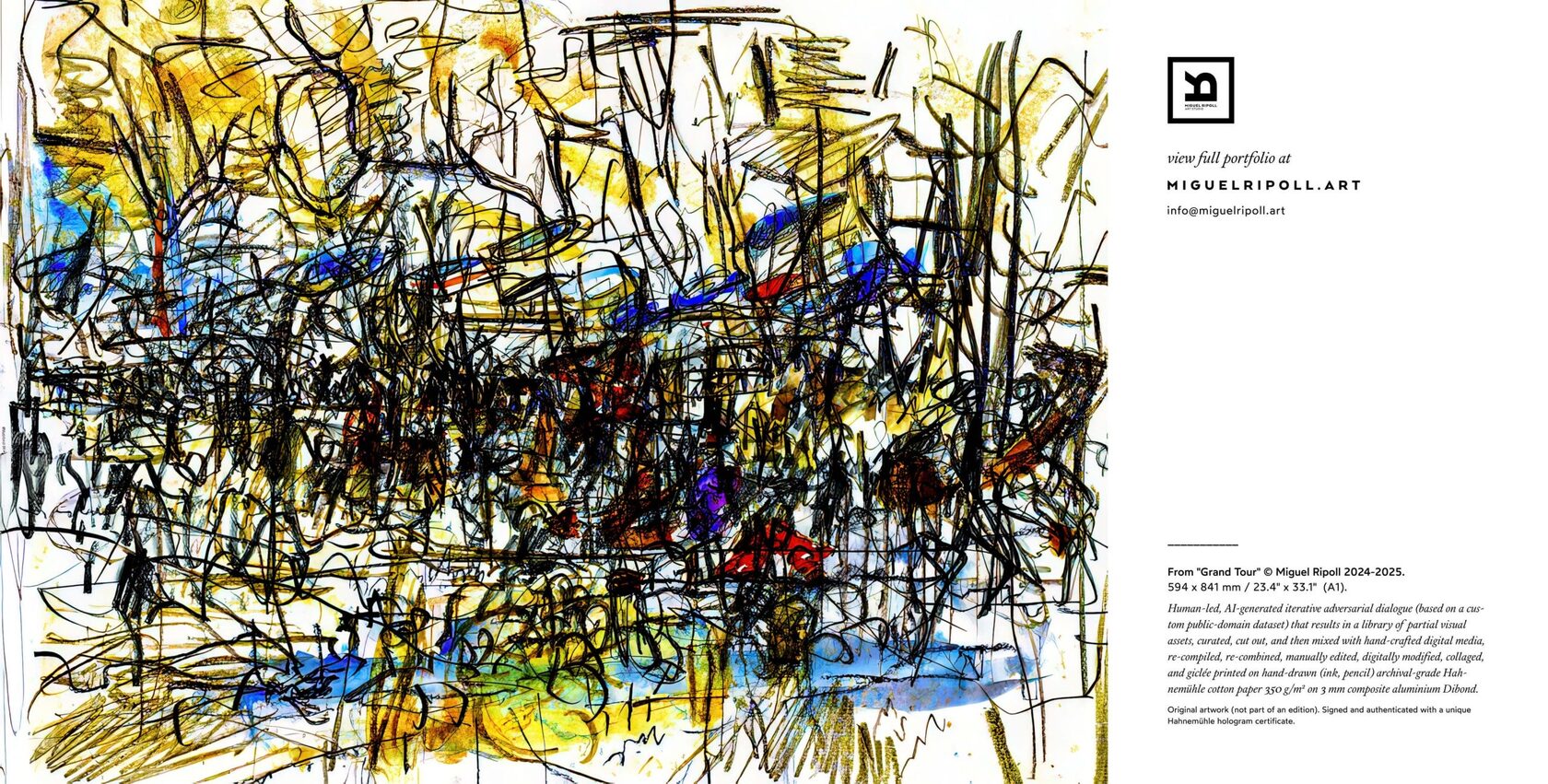
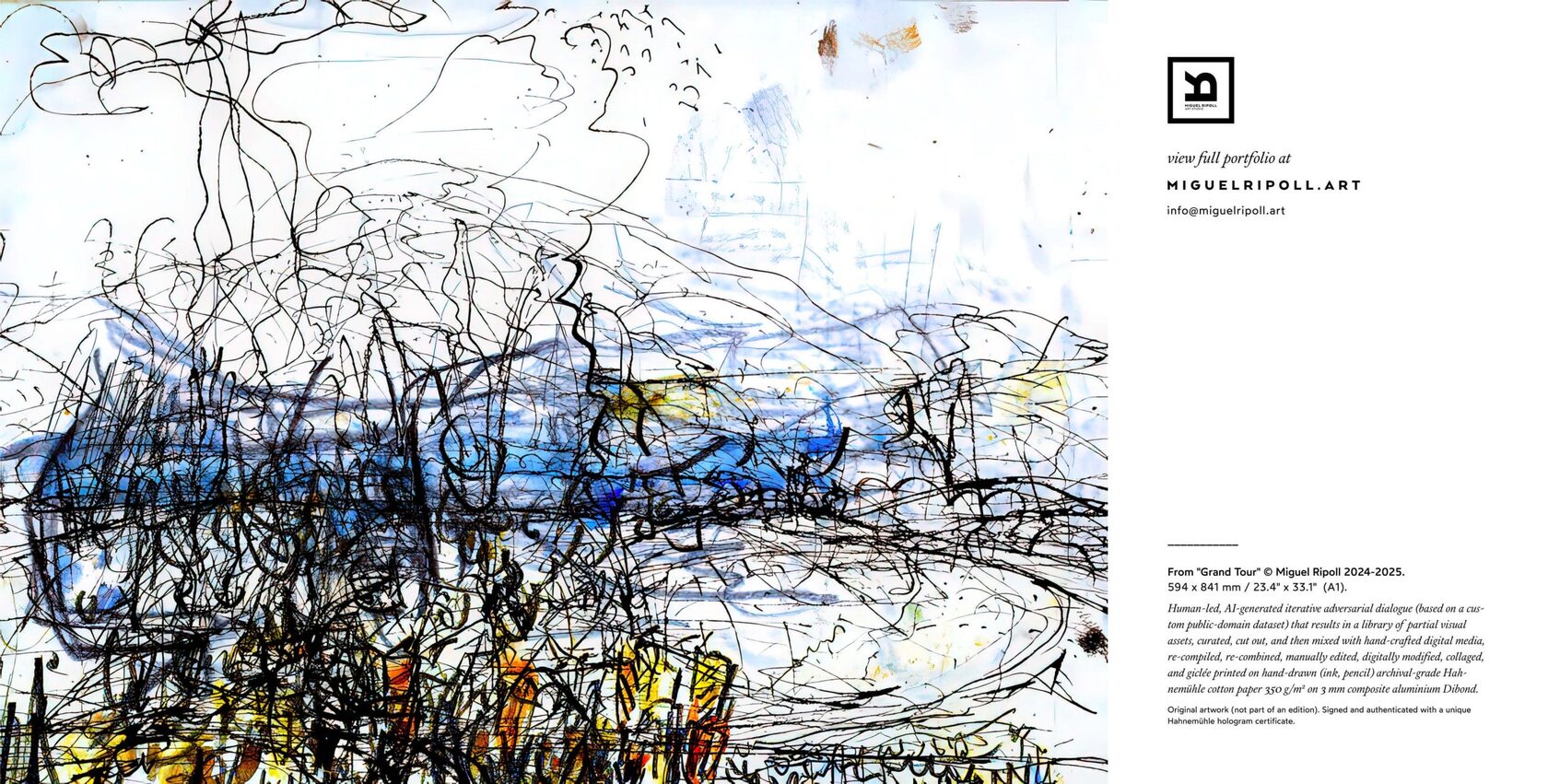
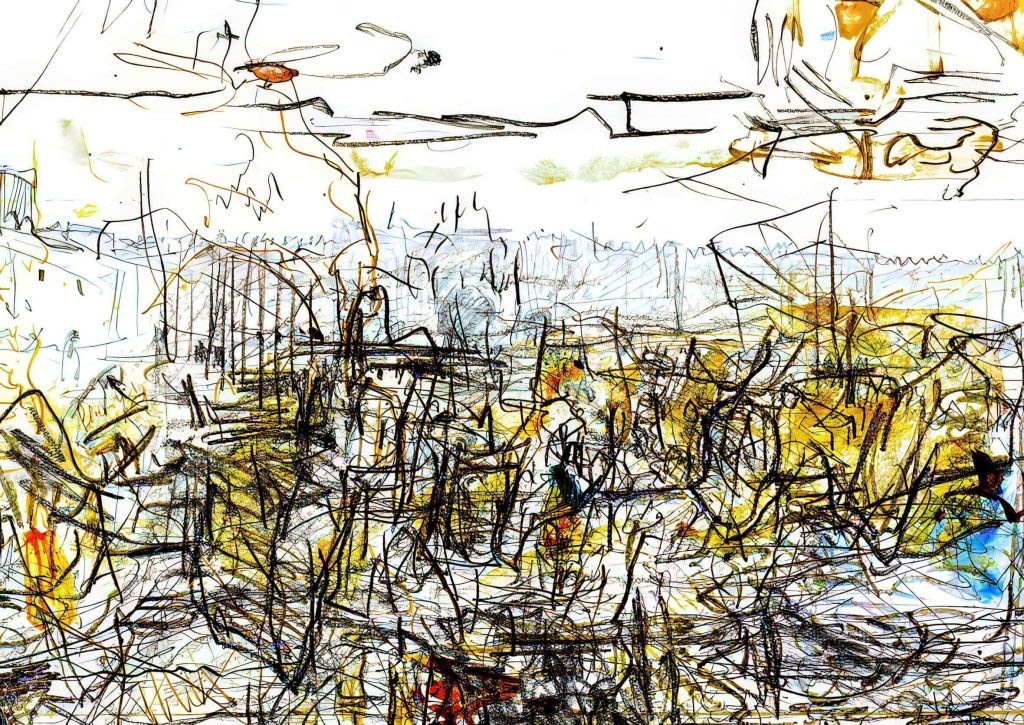
Grand Tour is a series of human-led, AI assisted phygital sketches that examine the enduring legacies of cultural representation, power, and mobility through geographies (both real and imaginary) in our hyper-connected world. Merging human-led generative AI with manual editing and hand-crafted mixed media techniques on large-scale paper, the project reflects on how historical narratives of travel and exploration continue to shape present-day perceptions of identity, geography, and belonging. Each work begins as an adversarial dialogue with machine learning models (trained on open-source custom datasets of art, history, and cartography) and is then extensively reworked by hand, both digitally and physically. The final compositions are printed on hand-drawn (pencil, ink) archival paper, creating a textured visual field that oscillates between machine precision and human tactility.
Through layered visual vocabularies, the series interrogates how systems of knowledge (such as maps, travel writing, and ethnographic imagery) construct hierarchies of value and meaning. While the aesthetics may echo travel brochures, panoramic paintings, or museum dioramas, they are deliberately destabilised: fragments repeat, symbols misalign, and familiar forms are re-framed or distorted. This disruption is not an error of the machine but a strategic intervention, inviting the viewer to question the neutrality of visual systems and the politics embedded in aesthetic conventions.
The technological process itself becomes a metaphor: AI here reveals its own embedded biases and gaps, surfacing tensions between automation and authorship. Rather than delegating creativity to the algorithm, the artist uses it as an adversarial partner, one that mirrors, amplifies, or resists the historical patterns the work seeks to critique.
By fusing historical reference with contemporary computation, Grand Tour constructs a reflective space where data, memory, and identity collide. It challenges viewers to consider not only what is seen but how seeing itself is structured through technology, through time, and through inherited systems of power and representation.


Made with AI, but not by AI
My artistic practice is defined by a hybrid approach that bridges AI technologies with slow, manual, and highly tactile traditional techniques. Central to my method is the use of large-scale paper drawings, where digital outputs generated through AI become raw material for physical reinterpretation. Rather than relying on AI for finalised images, I treat it as a dialogical tool — a machine collaborator that offers unexpected variations, which I then translate, disrupt, and reconstruct through hand-drawing, collage, digital manipulation, and layering processes. I see using AI not as a replacement for human creativity, but as a means to deepen the dialogue between perception, memory, and place. My process involves iterative cycles where digital and analogue modes constantly inform each other: AI-generated (not prompted) fragments are projected, traced, or redrawn by hand, allowing me to slow down, rethink scale, and engage physically with the work. This methodology resonates with my interest in text/texture, temporality and care — values that are often absent in purely digital workflows. Working on large paper surfaces allows for an embodied exploration of these AI-generated landscapes, embedding traces of my own gestures into the mechanical outputs. The resulting pieces are less about “perfect” renderings and more about revealing the frictions, gaps, and poetic accidents between machine logic and human interpretation. View the Grand Tour series and read more about its themes and methodology: https://miguelripoll.art