
Yun Ho & Romain Nith & Pedro Lopes
Embodied AI: letting computers speak through the body
In this video installation, we show a different form that an AI can take, and might take in a not-so-distant future. A form where, rather than speaking through words, an AI speaks through the body.
Drawing from long artistic traditions in media art via electrical muscle stimulation (e.g., Stelarc, Arthur Elsenaar, Remko Scha, Choy Ka Fai, Daito Manabe ), we endow an AI system with the ability to act directly on the user’s body through electrical impulses. Thus, the AI can manipulate and pose its wearer’s body to achieve physical tasks.
The viewer must contend with asking: “whose agency is this hybrid body-machine channeling: its user or the machine’s own goals as biases?”
This inverts the traditional paradigm of AIs that appear as chatbots, mimicking human language, and instead depicts an AI that acts using muscle movements of the user’s body.
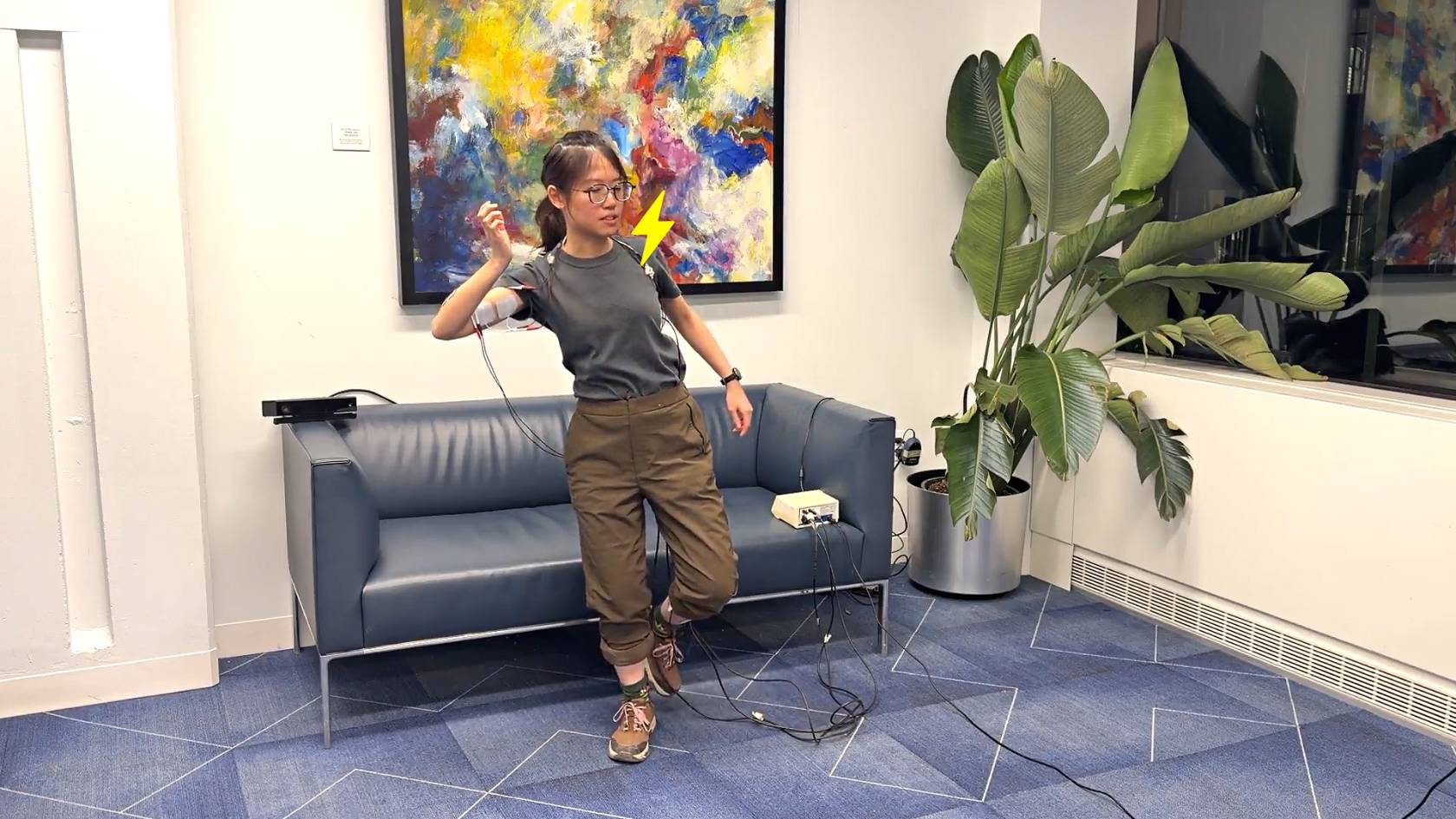

This video installation is built atop our technical system published at ACM CHI 2026 (“Generative Muscle Stimulation: Providing”, ACM Best Paper Award), but takes it into a more subversive territory. For instance, in it, we see a dancer who wishes to augment their creativity but ends up with a “hallucinated dance” (Chicago Twist, does not exist—machine fabrication), more akin to a creative glitch. Find out more at https://embodied-ai.tech/
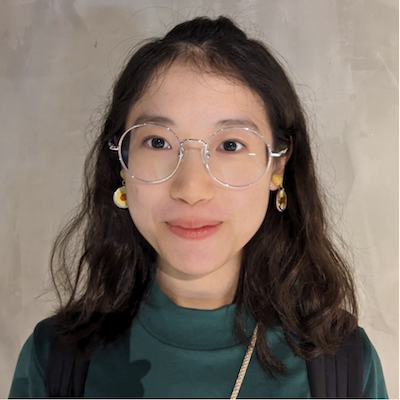
Yun Ho is a Computer Science Ph.D. student at the University of Chicago, advised by Professor Pedro Lopes. Her work focuses on Human-Computer Interaction. She explores how people make sense of and build relationships with physical assistance systems that communicate with users through proprioception (users’ own movements). In her free time, she enjoys dancing.
This artwork, Embodied AI, was done in collaboration with Romain Nith and Pedro Lopes in Human Computer Integration Lab.